
Shelving and Bookcase Ideas for Small Spaces
Practical shelving and bookcase ideas — going tall instead of wide, mixing open display with closed storage on the same unit, and choosing wall-mounted shelving that suits a rental.

In This Guide
The Right Shelving Can Do More Than Hold Books.
Shelving and bookcases are some of the highest-capacity furniture a small room can hold, but only when they're chosen and positioned deliberately. The same floor footprint can hold vastly different amounts depending on height, and the same unit can either put every item on display or hide the ones that don't need to be seen.
This guide focuses on four practical ideas: going tall instead of wide to get more capacity from the same footprint, mixing open display with closed storage on the same unit, choosing shelving that suits a rental, and letting a shelving unit anchor a zone rather than just hold things.
None of it requires built-in cabinetry. Freestanding and wall-mounted shelving can do all of this on their own, chosen and positioned with a bit more intention.
01 · Go Tall Instead of Wide
The Same Footprint Can Hold Far More.
A wide, low bookcase and a tall, narrow one can occupy the exact same floor footprint while holding very different amounts. In a small room, the tall option almost always wins — it uses the vertical space most rooms leave completely empty above eye level, without taking up any more floor than a shorter piece.
This applies just as directly to floating shelves as it does to a freestanding bookcase — a single tall column of shelves reaching toward the ceiling holds noticeably more than the same shelves spread wide and low across a shorter run of wall.
This is the same principle covered in how to make a small room feel bigger — when floor space is limited, the walls need to work harder, and shelving is one of the most direct ways to put that into practice.
Solves This
Set of 4 Latitude Floating Shelves
A wall-mounted set that goes as tall as the wall allows, without taking up any of the room's floor footprint.
£12.99 · Shop This Pick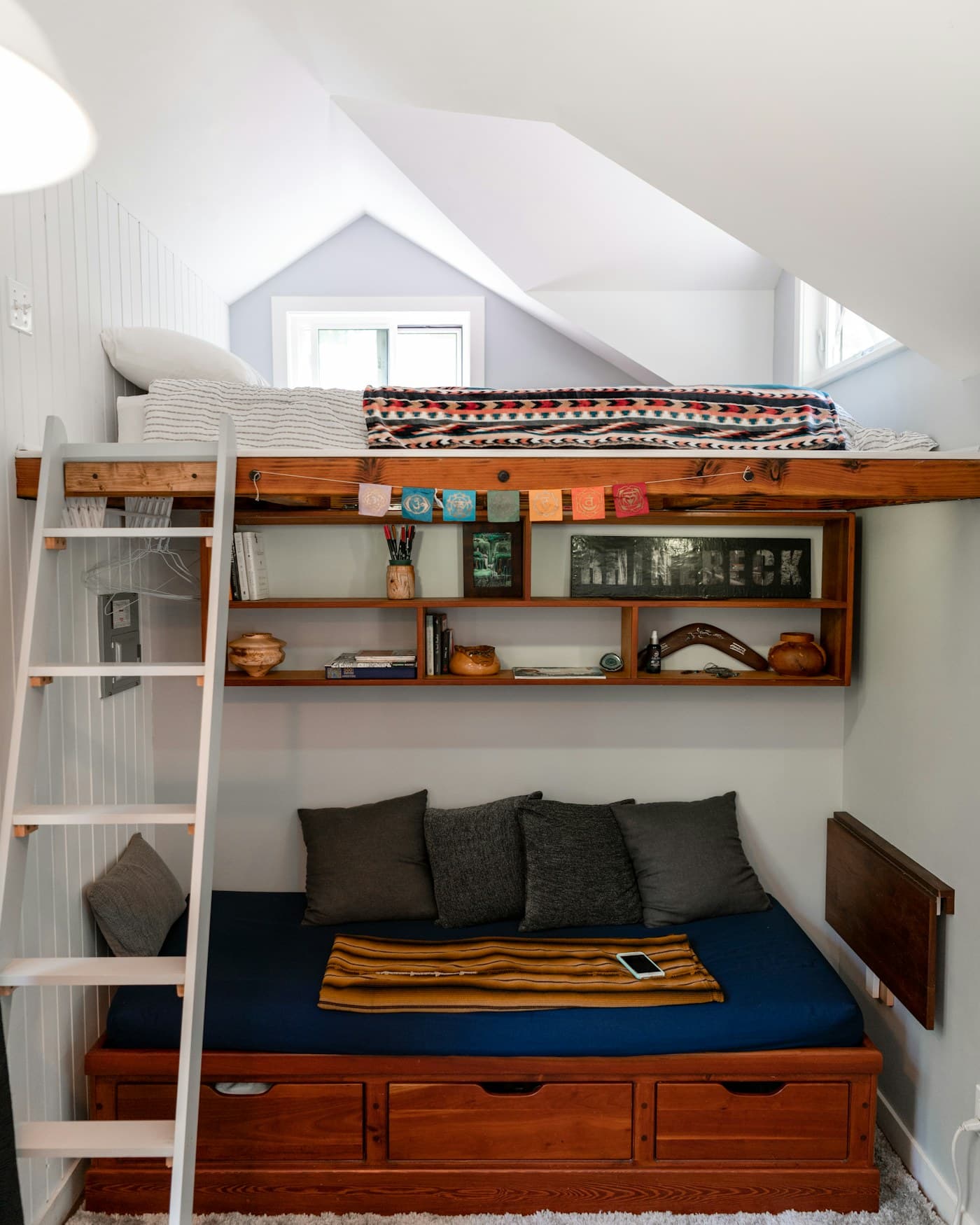
- 01Choose Height Over WidthA tall, narrow unit holds more than a wide, low one in the exact same floor footprint.
- 02Extend Shelving Closer to the CeilingThe upper third of most rooms is left completely unused — shelving is one of the simplest ways to claim it.
- 03Reserve the Top Shelf for What You Rarely NeedThe hardest-to-reach shelf should hold what's used least often, not everyday items.
- 04Keep a Step Stool Nearby if You Go TallThe upper shelves of a genuinely tall unit will need a stool to reach comfortably.
RoomMinded Tip
Two bookcases can share the same floor footprint and hold completely different amounts, depending on how tall one of them is.
02 · Mix Open Display With Closed Storage
Not Everything on a Shelf Needs to Be Seen.
A shelving unit filled entirely with open shelves puts everything on display, whether or not it's something you'd actually want visible — mismatched cables, paperwork, anything that doesn't look tidy sitting in the open. A unit that combines open shelves with a closed cabinet section, or a few baskets on the open shelves themselves, solves this without giving up any of the height or capacity.
Books, plants and décor tend to suit open display well. Anything you'd rather not see — chargers, spare stationery, odds and ends — belongs behind a closed door or inside a basket on the same unit rather than left out just because the shelf happened to be open.
This mirrors the storage-versus-display balance covered in small living room storage ideas — open storage works best for what you don't mind seeing, and closed storage should handle the rest.

- 01Reserve Open Shelves for What Looks Tidy OutBooks, plants and décor suit open display — anything messier belongs behind a door or in a basket.
- 02Use Baskets on Open Shelves for the RestA basket on an open shelf gives closed-storage privacy without needing a fully enclosed unit.
- 03Balance the Unit VisuallySpread closed sections and open sections across the unit rather than stacking all of one type together.
- 04Don't Feel Obligated to Fill Every ShelfA shelf with some breathing room reads as more intentional than one crammed edge to edge.
03 · Choose Shelving That Suits a Rental
Wall-Mounted Doesn't Have to Mean Permanent.
Wall-mounted shelving sounds like it requires drilling into a wall you might not be able to alter, but a range of lightweight shelving systems are designed to mount with adhesive strips or brackets rated for renter-friendly use, holding real weight without needing to fill a hole when you move out.
A freestanding bookcase is the more straightforward renter-friendly option when in doubt — it leaves the walls completely untouched and moves with you as a single piece of furniture. The trade-off is floor footprint, which matters more in a genuinely tight room.
See renter-friendly decorating ideas for more on furnishing a small space you can't permanently alter.
- 01Check the Weight Rating Before MountingA lightweight adhesive shelving system still has a real weight limit — check it against what you plan to store.
- 02Choose a Freestanding Bookcase in DoubtIt leaves the walls completely untouched and moves with you as a single piece of furniture.
- 03Weigh Floor Footprint Against Wall DamageA freestanding option costs floor space; a wall-mounted one costs a small amount of wall alteration.
- 04Keep Fixings From a Rental Move-InSome rentals allow small picture hooks — check your lease before assuming shelving isn't an option at all.
RoomMinded Tip
Wall-mounted shelving and a rental aren't automatically incompatible — it depends entirely on which system you choose.
04 · Let the Shelving Anchor a Zone
A Shelf Can Do More Than Hold Things.
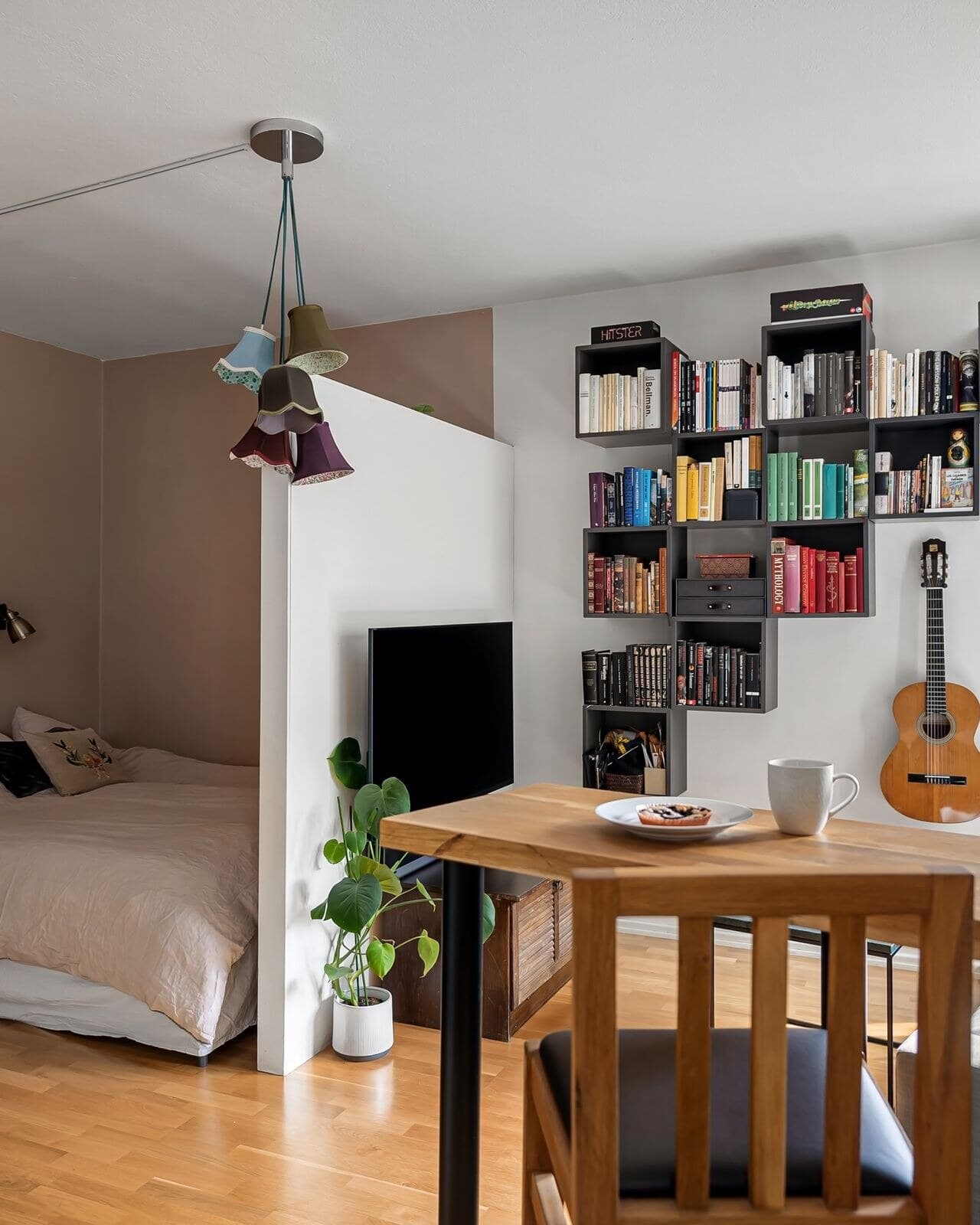
Beyond storage, a tall bookcase or a run of shelving can quietly define a zone in a room without any function of its own beyond holding books and décor — placed behind a desk corner, beside a reading chair, or along the edge of a dining nook, it signals "this is a different part of the room" the way a wall would in a larger apartment.
This works especially well in a studio or one-bedroom apartment, where zones share one open room and shelving can act as a visual — sometimes even physical — divider without ever becoming a full partition wall.
See how to zone a studio apartment without walls for more on using furniture, including shelving, as a zoning tool.
Take This With You
- 01Use Shelving to Mark a Zone BoundaryA tall bookcase can define where one part of a room ends and another begins, without a wall.
- 02Position It Where a Wall Would Naturally GoPlacing shelving along a zone's edge makes the divide read as intentional rather than incidental.
- 03Choose an Open-Backed Unit for a Softer DivideShelves open on both sides let light and sightlines pass through, which suits a genuinely small room.
- 04Combine With the Room's Other Zoning CuesA rug or furniture angle on either side of the shelving reinforces the same zone boundary.
Next·Explore More Small Space Storage Ideas
RoomMinded Picks
Pieces That Make
This Easier.
A few products that make shelving and bookcase ideas easier to put into practice.
Storage · Floating Shelves
Set of 4 Latitude Floating Shelves
A wall-mounted set that goes as tall as the wall allows, without taking up any of the room's floor footprint.
£12.99
View Product
Small Space · Storage
Slim Storage Cabinet
A narrow, closed-storage option to pair beside open shelving for anything that shouldn't be on display.
£49.99
View Product
Storage · Woven Baskets
VonHaus Seagrass Storage Baskets, Set of 4
Baskets sized to sit on an open shelf, giving closed-storage privacy to anything you'd rather not have on full display.
£22.99
View Product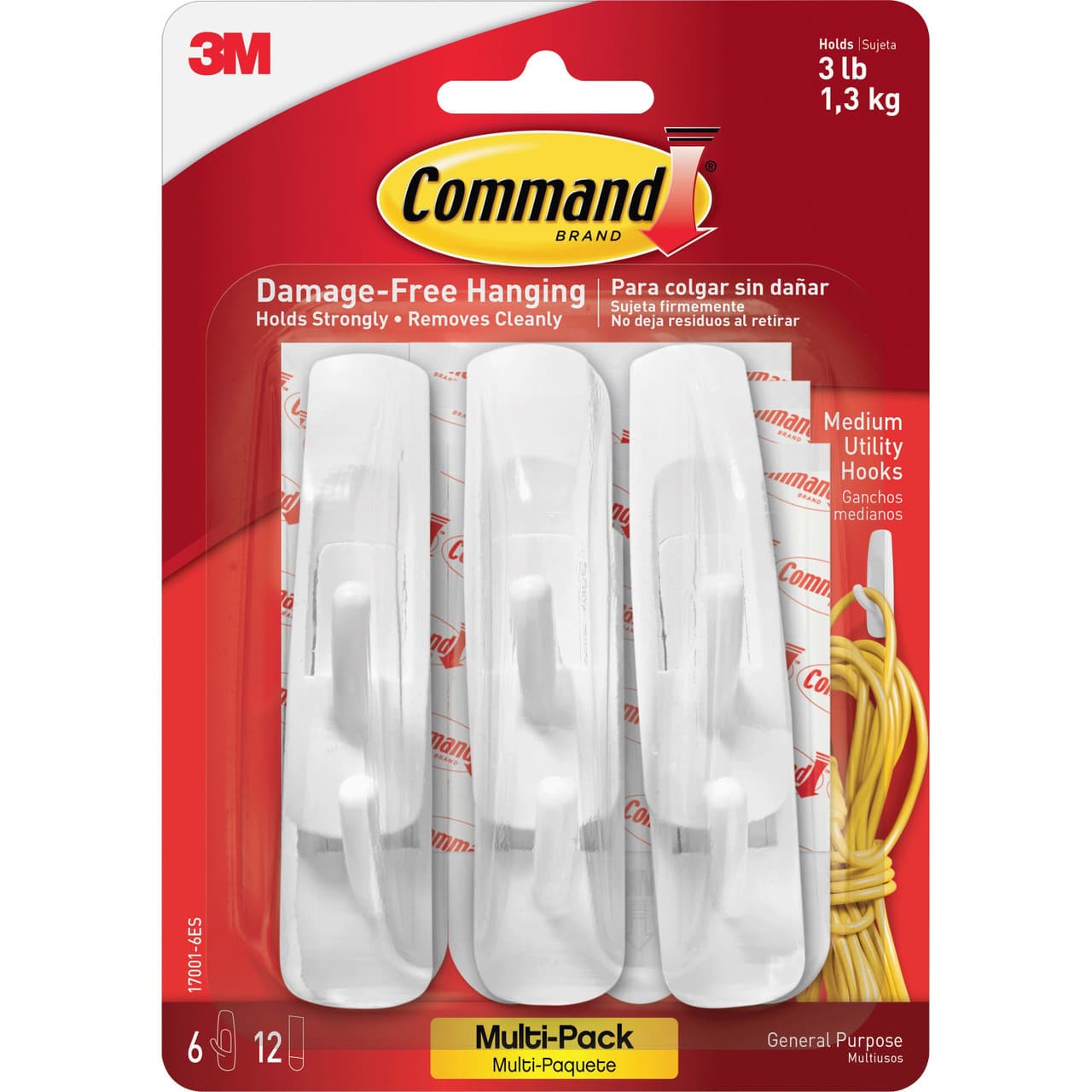
Renter-Friendly · Adhesive Hooks
3M Command Medium Utility Hooks (White)
A damage-free way to hang light décor or a small item beside a shelving unit without adding another drilled hole.
£17.08
View ProductThese are curated recommendations. If you purchase through one of our links, RoomMinded may earn a commission at no extra cost to you.
Keep Exploring
More Ideas for
Better Spaces.
A few more practical RoomMinded guides worth reading next.
Storage & Organization
Vertical Storage Ideas for Small Apartments
A room-agnostic guide to vertical storage — wall space, over-door options and stacking strategies that work in any small room.
Read Guide
Living Room
Small Living Room Storage Ideas
Furniture that hides storage in plain sight, media and cable clutter kept out of view, and using the wall behind the sofa.
Read GuideStorage & Organization
Small Closet Organization Ideas
Practical small closet organization ideas — using vertical space, sorting by frequency of use, and containers that keep everything visible.
Read GuideGood to Know
Questions You
Might Have.
A few practical answers to common questions.
For capacity, yes — a tall, narrow unit holds more in the same floor footprint as a shorter, wider one, since it uses the vertical space most rooms leave completely unused.
Neither, ideally. Mixing open shelves for what looks tidy on display with a closed section or baskets for the rest gets the benefits of both without giving up capacity.
Some lightweight systems mount with adhesive strips or renter-friendly brackets rated for real weight. If in doubt, a freestanding bookcase leaves the walls completely untouched.
Yes — an open-backed unit placed along a zone's edge marks a boundary without becoming a full wall, and still lets light and sightlines pass through.
If every shelf is crammed edge to edge, it usually reads as busier than intended. Leaving some breathing room, and moving less tidy items into closed storage, tends to fix it.
Keep Making Your Space Work Better
Ready to Make
Your Space Work Better?
Explore more practical room ideas, smart solutions and thoughtfully chosen products for real homes and everyday living.